
Introduction
Color correction in jewelry photography plays an important role in online sales, since customers depend on product images to understand the color, finish, and details of jewelry before making a purchase.
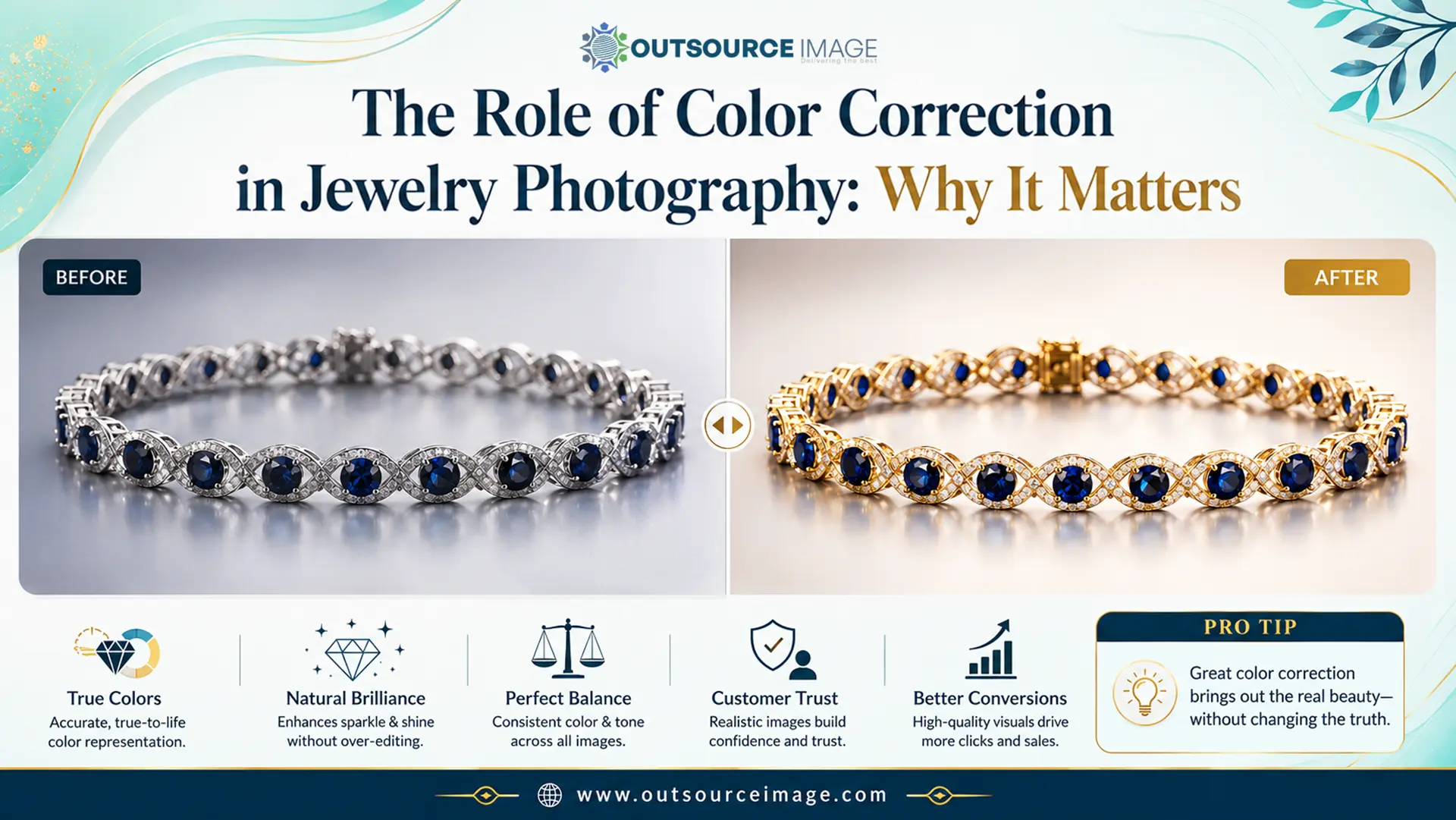
Even small color problems can make yellow gold look orange, white gold appear gray, or gemstones look unnatural. For this reason, color correction in jewelry photography helps create accurate, attractive, and consistent product images while preserving the jewelry’s natural appearance. When paired with careful jewelry image retouching, color correction gives online shoppers a true sense of what they are buying before it ever arrives at their door.
What Is Color Correction in Jewelry Photography?
Color correction is the process of adjusting the colors and tones of a jewelry photograph so the product looks natural and accurate. In practice, professional editing may include adjustments to:
- White balance
- Exposure and brightness
- Contrast
- Highlights and shadows
- Color temperature
- Saturation
- Metal tones
- Gemstone colors
Why Jewelry Photos Need Color Correction
Jewelry is highly reflective, so it easily picks up unwanted colors from studio lighting, backgrounds, props, or nearby surfaces. For instance, warm lighting can make white gold appear yellow, while a colored background can create unwanted reflections on polished metal. This happens because color perception is relative — the same tone can look different depending on surrounding light, a concept explained in general color-theory resources such as the Encyclopaedia Britannica’s overview of color perception.
As a result, professional jewelry photo editing corrects these issues without changing the product’s actual appearance.
Why Color Correction Matters for Jewelry Photography
1. Color Correction Builds Customer Trust
Since online shoppers cannot physically examine jewelry before purchasing, product photographs need to represent the item as accurately as possible.
For example, if a rose-gold bracelet appears copper-colored online but looks different in person, the customer may feel misled. Accurate color correction therefore closes the gap between photograph and product, helping customers buy with confidence and reducing returns.
2. Color Correction Preserves Natural Gemstone Colors
Gemstones have different levels of hue, tone, saturation, and brilliance, so editing should improve their visibility without changing their natural appearance.
However, excessive saturation can make a sapphire look unnaturally blue, while excessive brightness can make an emerald lose its natural depth. Good gemstone photo editing instead improves exposure, contrast, and color balance while preserving the stone’s original character.
3. Color Correction Shows Metal Tones Accurately
Different metals respond differently to lighting and reflections:
- Yellow gold should retain its natural warm golden tone.
- Rose gold should maintain its subtle pink appearance.
- White gold should look clean and neutral.
- Silver should appear bright and natural.
- Platinum should maintain its neutral metallic appearance.
Because incorrect white balance can significantly change these colors, accurate metal color is especially important when a brand offers the same design across multiple metal options, since customers often compare variants side by side.
4. Color Correction Creates a Consistent Product Catalog
Jewelry brands may have hundreds or thousands of product photographs. If each image has different brightness, color temperature, or background appearance, the website can look inconsistent.
To avoid this, a professional editing standard maintains consistent color balance, brightness, background appearance, and contrast — ultimately creating a more professional store and strengthening brand identity.
Common Color Problems in Jewelry Photography
Incorrect White Balance Silver may appear blue, while gold can become excessively orange when white balance is off.
Unwanted Color Casts Similarly, reflective jewelry can pick up colors from backgrounds, props, clothing, and studio surfaces, requiring careful correction.
Overexposed Highlights Meanwhile, polished metals and gemstones often produce strong reflections that can remove important surface and setting details.
Dull Gemstones On the other hand, underexposure can make gemstones look dark and flat. Controlled adjustments to exposure and color balance restore depth without making the stone look artificial.
Uneven Backgrounds Finally, differences in background brightness or color across a catalog can make an e-commerce store appear unprofessional.
Color Correction vs. Jewelry Retouching
Color correction and jewelry retouching work together but serve different purposes. On one hand, color correction focuses on white balance, exposure, brightness, contrast, color temperature, metal tones, and gemstone colors. On the other hand, jewelry retouching typically covers dust and mark removal, reflection cleanup, surface refinement, background cleanup, edge correction, and gemstone enhancement.
That said, over-editing can make a gemstone appear brighter or clearer than it really is, so professional editing should enhance the photograph while maintaining product accuracy. For a closer look, see our breakdown of jewelry retouching techniques, which covers how shine and surface cleanup are handled separately from color work.
Jewelry Photo Editing Workflow for Color Correction
Typically, a professional color correction workflow for jewelry photography includes these steps:
- Review the Original Image — Identify exposure, color, reflection, and background problems.
- Establish a Neutral Reference — Compare the photo against neutral tones or an accurate product reference.
- Correct White Balance — Remove unwanted warm or cool color casts.
- Balance Exposure and Contrast — Adjust highlights and shadows while preserving detail.
- Refine Metal and Gemstone Colors — Correct tones without making them look unrealistic.
- Match the Product Collection — Keep colors and brightness consistent within a collection.
- Quality Check — Review for unnatural colors, excessive saturation, and lost detail.
- Export for E-Commerce — Prepare files in the correct format and resolution for websites and marketplaces.
How to Choose a Jewelry Photo Editing Company
Since choosing the right partner for color correction in jewelry photography matters for brands handling large volumes of product photography, it helps to look for a provider offering:
- Experience with jewelry and gemstones
- Professional color correction
- Consistent editing quality
- Before-and-after samples
- Bulk editing capacity
- Reliable turnaround times
- Clear revision policies
- Secure file handling
Above all, a professional provider understands the difference between enhancing a photograph and changing the product’s actual appearance. You can see this in practice on our jewellery photo editing services page, which outlines our full scope of work for jewelry brands and photographers.
Frequently Asked Questions
Why is color correction important in jewelry photography? It helps photographs represent the product’s natural colors accurately, improving consistency and customer confidence.
How do you correct gold color in jewelry photos? Typically, gold color is corrected by adjusting white balance, color temperature, saturation, and individual color values against an accurate product reference.
Can color correction improve gemstone appearance? Yes — it improves exposure, contrast, and color balance while keeping the gemstone’s natural appearance.
What is the difference between color correction and jewelry retouching? In short, color correction targets color and tonal accuracy, while retouching addresses dust, reflections, surface flaws, edges, and background distractions.
Can color correction be used for large jewelry catalogs? Absolutely — a standardized workflow maintains consistent color, brightness, and background appearance across large volumes of images.
Conclusion
Ultimately, color correction in jewelry photography is an important part of professional product image editing. It helps preserve gemstone colors, display metal tones accurately, control unwanted color casts, recover important details, and maintain consistency across jewelry catalogs.
For e-commerce brands, product photography is often the closest customers get to the jewelry before purchasing. Therefore, accurate and professional images help shoppers understand the product and make more confident decisions. The goal of color correction is not to make jewelry look unrealistic — instead, it is to show the jewelry’s true beauty in the best possible light.
Give Your Jewelry Images a Professional Finish
Are your jewelry photographs too warm, dull, dark, or inconsistent?
Outsource Image provides professional jewelry photo editing services, including color correction, gemstone enhancement, metal-tone adjustment, background matching, shine enhancement, and jewelry retouching.
Send us a sample image to receive an expert recommendation and editing quote.
Email: sales@outsourceimage.com
Phone: +91 93454 50713
Website: Outsource Image
Get a Free Quote | Request a Free Sample Edit | Talk to a Photo Editing Expert