
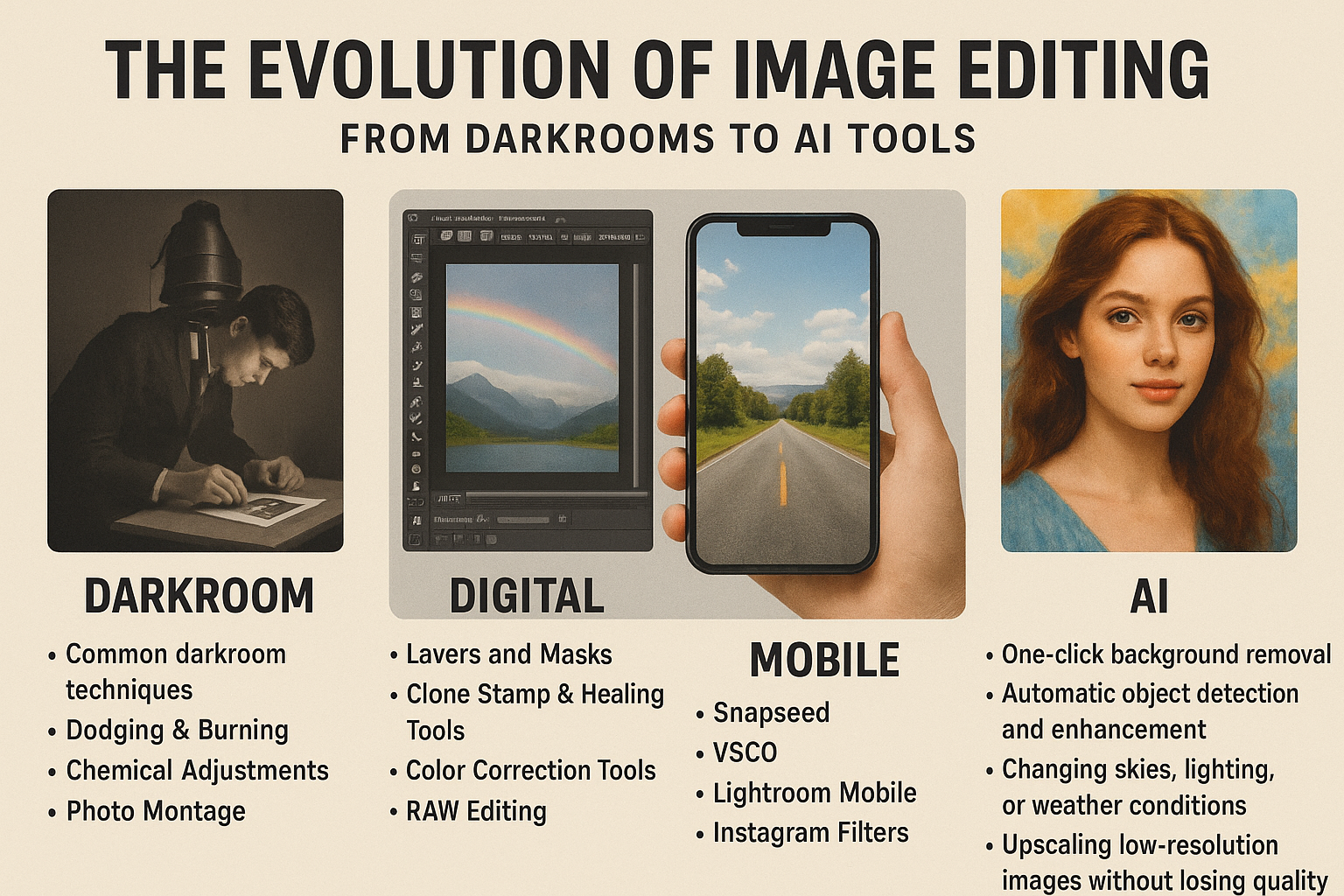
Image editing has come a long way—evolving from chemical-filled darkrooms to sophisticated artificial intelligence tools that can transform photos with a single click. As photography and technology evolved side by side, the way we enhance images continuously shifted, becoming faster, more accessible, and more creative. Consequently, AI has revolutionized modern editing workflows, making advanced capabilities available to everyone—not just professional photographers.
In this blog, we take a journey through the major milestones in the evolution of image editing — closely related to how image editing differs from image retouching.
1. The Darkroom Era: Where Image Editing Began
To begin with, long before digital screens and editing apps existed, image manipulation started in the darkrooms of film photographers. In this space, creativity wasn’t limited to capturing the perfect shot—instead, it extended deeply into how the film was processed.
Common Darkroom Techniques
- Dodging & Burning: Lightening or darkening specific parts of an image manually.
- Chemical Adjustments: Altering contrast, exposure, and tone using chemical baths.
- Photo Montage: Manually combining negatives to create early “composites.”
Ultimately, these techniques required extreme precision, immense patience, and a deep understanding of both chemistry and photography. While they were incredibly time-consuming, they nevertheless produced some of the most iconic images of the 20th century.
2. The Rise of Digital Editing: Photoshop Changes Everything
Moving forward, the 1990s marked a true revolution in the industry. With the arrival of digital cameras and Adobe Photoshop, image editing finally left the darkroom and entered the desktop.
Key Advancements in Digital Editing
- Layers and Masks: Allowing for non-destructive editing workflows.
- Clone Stamp & Healing Tools: Making precision retouching seamless.
- Color Correction Tools: Giving editors full control over tones and hues.
- RAW Editing: Offering unprecedented high-quality image adjustments.
As a result of these innovations, editing became far more flexible and vastly more powerful. In fact, what used to take hours in a darkroom could suddenly be done in minutes on a computer screen. Moreover, businesses soon realized that utilizing professional photo editing was essential for creating polished commercial visuals.
3. Mobile Editing and Apps: Editing on the Go
Subsequently, as smartphones equipped with powerful cameras became widespread, editing tools naturally followed the mobile trend.
For instance, popular apps like Snapseed, VSCO, Lightroom Mobile, and Instagram Filters quickly brought professional-grade editing tools directly to everyday users. By using simple sliders for contrast, saturation, highlights, and shadows, these apps turned casual photography into a creative hobby for millions of people almost overnight.
4. AI Image Editing: The New Generation
Today, we are witnessing another massive shift. Tools like Adobe Firefly, Midjourney, DALL·E, and Canva AI have completely reshaped how creators work. Indeed, even absolute beginners can now perform complex edits that previously required years of expert-level skills.
What AI Image Editing Can Do
- One-click background removal
- Automatic object detection and enhancement
- Dynamic adjustments to skies, lighting, or weather conditions
- Upscaling low-resolution images without losing quality
- Portrait retouching using smart facial recognition
- Colorizing old black-and-white photos
- Generating entirely new images from text prompts
However, as automated tools become standard, many creators are evaluating the precision of a traditional clipping path vs AI background removal to see which method yields the cleanest results for complex shapes.
5. Why AI Editing Matters
Crucially, AI hasn’t replaced human creativity; rather, it has amplified it. Instead of spending hours on repetitive technical tasks, creators can now focus entirely on storytelling and design.
Benefits of AI Editing
- Speed: Edits that once took hours now take only seconds to complete.
- Accessibility: Professional results no longer require years of advanced training.
- Consistency: Automated tools easily maintain uniform quality across entire batches of photos.
- Innovation: Furthermore, AI unlocks entirely new creative possibilities, from generative art to photorealistic composites.
In addition to personal use, AI tools are also rapidly transforming commercial industries such as marketing, filmmaking, and social media content creation. Particularly in retail, implementing these swift updates serves as a highly effective e-commerce growth strategy to capture buyer attention quickly.
6. The Future of Image Editing
Looking ahead, as AI models become even more powerful, image editing will continue to evolve rapidly. In the near future, we can expect:
- Real-time AI editing directly inside the camera during a live shoot.
- Fully automated visual branding solutions optimized for online businesses.
- More advanced 3D and AR/VR image manipulation capabilities.
- Hyper-realistic generative visuals that beautifully blend photography and imagination.
Therefore, one thing remains certain—the journey from darkrooms to AI has only just begun. The next decade will undoubtedly reshape what we consider “editing” altogether.
Final Thoughts on the Evolution of Image Editing
In conclusion, image editing has successfully transformed from a hands-on chemical process to a digital art form powered by artificial intelligence. Whether you’re a professional photographer, a designer, a marketer, or just a casual smartphone user, today’s tools offer limitless creative potential.
As AI continues to evolve, the future of image editing promises to be faster, smarter, and more imaginative than ever before — much like how professional image editing increases e-commerce sales today.