
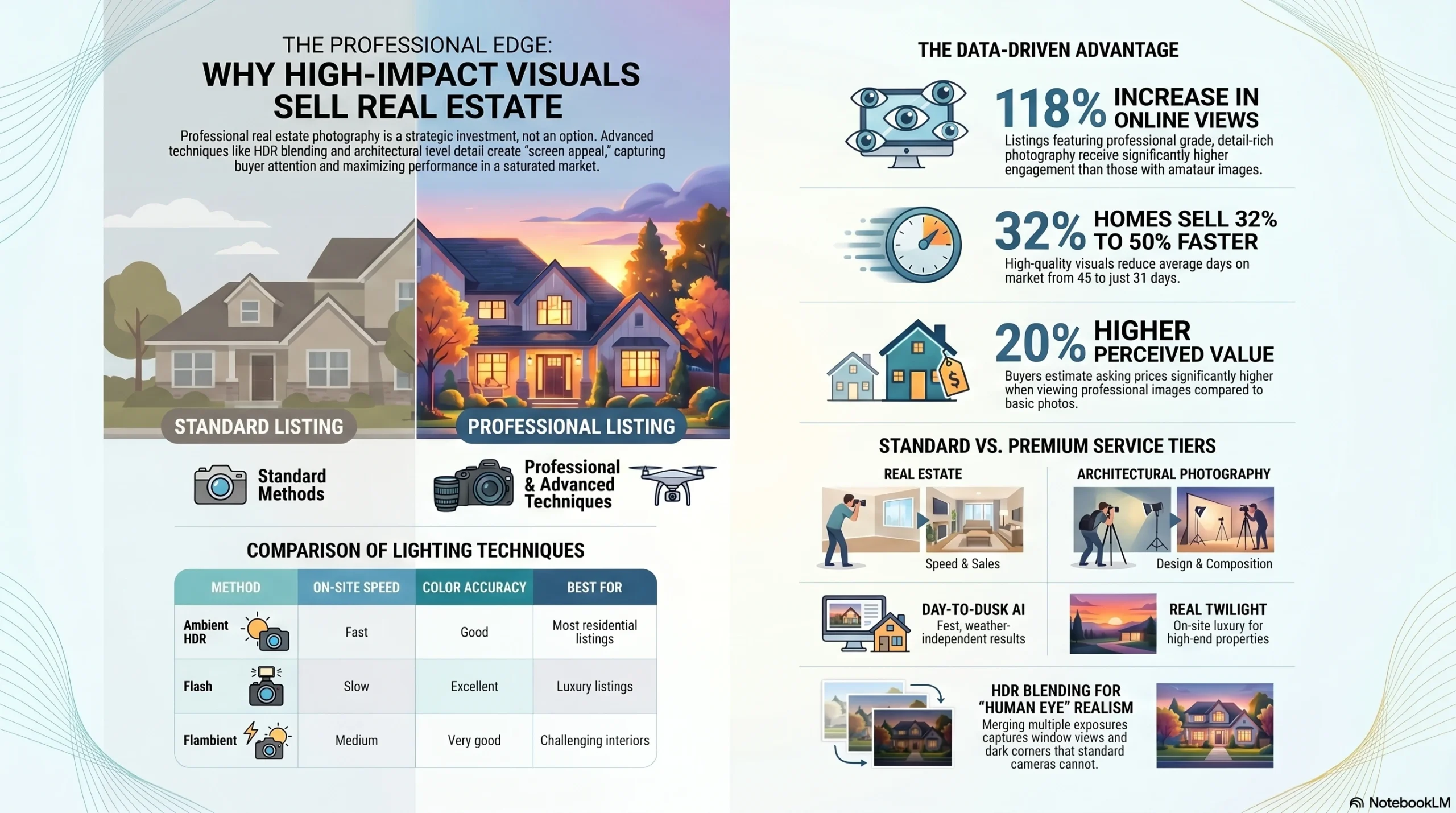
In today’s digital era, a property’s online listing serves as its first open house — and Real Estate HDR Photography is what makes that listing shine. Data shows that over 97% of prospective buyers start their real estate search online. Consequently, the visual appeal of these photos is a major factor in driving buyer interest. Despite this, many real estate professionals still rely on basic smartphone photos or single-exposure images that fail to represent the property well.
The primary technical challenge is dynamic range. The human eye easily handles the contrast between a dark interior hallway and a bright window view. Camera sensors, however, are more limited. If you expose the photo for the interior, the windows often appear as bright, empty white spaces. If you expose for the window, the interior becomes too dark to see.
Real Estate HDR Photography helps bridge this gap. By capturing multiple exposures of the same scene and blending them, editors can create a final image that closely mimics how we see, showing details in both the dark shadows and the bright windows.
The Financial ROI: Why Real Estate HDR Photography Pays for Itself
For developers, agents, and photographers, professional Real Estate HDR Photography is more than just an artistic choice—it is a practical tool that can yield a measurable return on investment (ROI).
Faster Sales
Properties with professional photos tend to sell much faster. Research from Redfin and VHT Studios suggests that professionally photographed homes sell 32% to 50% faster than those with amateur photos, potentially reducing the average time on the market from 45 days to 31 days.
Higher Perceived Value
The quality of a listing’s images directly affects how much a buyer thinks the home is worth. One study found that buyers estimated a property’s value to be up to 21% higher when viewing professional images rather than basic photos. Professional photography can also help increase the final sale price, with some homes selling for thousands of dollars more depending on their price range.
Stronger Buyer Engagement
Listings with HDR photos generally attract more traffic, sometimes generating over 100% more online views than standard listings. Eye-tracking studies also show that buyers spend about 60% of their time looking at the photos, compared to only 20% reading the written description.
The 15-Minute Rule: On-Site Preparation Secrets – Real Estate HDR Photography
Before starting any Real Estate HDR Photography shoot, basic on-site preparation is necessary to get clean shots. Because real estate photographers work on tight schedules, efficiency is essential. Many follow a “15-minute rule,” dedicating no more than 15 minutes to quick decluttering before they begin shooting.
Staging Tips
To keep the images clean and professional, clutter should be hidden from view. Key items to remove include toothbrushes, trash cans, pet beds, bath mats, and loose power cords.
Handling Windows and Blinds
Window blinds can be tricky. The standard practice is to pull them up completely to let in natural light. However, there are exceptions: if the view outside is unappealing (like a construction site), if the agent requests them down, or if the blinds are fragile and risk breaking.
It is also important to turn off moving features like ceiling fans, televisions, and active fireplaces. Because HDR involves blending multiple exposures, any movement can cause blurry “ghosting” effects in the final image.
Technical Mastery: Camera Settings & The “Window Pull” (Real Estate HDR Photography)
Camera Stability & Exposure Setup
Real Estate HDR Photography requires absolute stability. A sturdy tripod is essential, as even slight movements between bracketed shots can cause alignment errors and blurry images. To prevent camera shake, photographers often use a 2-second timer or a remote shutter release.
Recommended camera settings include keeping the ISO at 100 to avoid digital noise and setting the aperture between f/7.1 and f/11 (f/8 is a common default) to keep the entire room in sharp focus. Photographers should shoot in RAW format to capture the most detail, using Auto Exposure Bracketing (AEB) to take three to five different exposures (such as -4, -2, 0, +2, and +4 EV).
Mastering the Window Pull
The “window pull” is a helpful technique for interior real estate shots. Standard HDR blending sometimes leaves windows looking washed out. To fix this, an editor takes a darker exposure—where the outdoor view is properly exposed—and carefully blends it into the final image. This keeps the outdoor scenery visible instead of a bright white void.
Overcoming Mixed Lighting Challenges
A common challenge in interior photography is mixed lighting. This happens when warm, yellow indoor lightbulbs clash with the cool, blue daylight from windows.
To prevent this color clash, photographers can use a luminosity blending technique. First, they shoot the bracketed HDR sequence with the indoor lights turned off. Then, they take a single photo with the lights turned on. In editing, the “lights-on” photo is layered over the natural light composite. This approach adds the warm glow of the light fixtures without ruining the color balance of the room.
The Editing Workflow: Avoiding the “Cartoon” Look (Real Estate HDR Photography)
The main goal of HDR editing is to make the image look natural. In the past, HDR real estate photos gained a reputation for looking “cartoonish,” with harsh contrast, unnatural halos around windows, and overly saturated colors.
Modern editing relies on a more subtle approach. Editors adjust highlights to prevent glowing halos around lamps and gently lift shadows to keep the room’s natural depth. It is also important to correct geometric distortion. Straightening vertical walls and leveling ceilings are necessary steps to make the photo look professional.
Because blending these exposures can be time-consuming, busy photographers often partner with editing services. Working with a dedicated provider like Outsource Image can help keep your photos consistent and natural while saving you editing time.
Pushing the Boundaries: AI, Video, and Modern Tech
New technology and AI are changing how real estate marketing works.
Virtual Twilight (Day-to-Dusk)
Traditional twilight photography is difficult. It requires great weather, precise timing, and an expensive evening shoot during a brief 20-minute window. Today, our day to dusk photo editing service offers a simpler alternative. Editors can transform a daytime exterior photo to show warm sunset lighting and glowing windows. This provides the same visual appeal without the logistical challenges.
To offer these services, many real estate professionals work with services like Outsource Image, alongside our 360 panorama editing for full immersive listings. Their editors handle day-to-dusk conversions, virtual staging, and lawn enhancements to make listings look their best.
Ethics and Business Realities – Real Estate HDR Photography
It is helpful to distinguish real estate photography from architectural photography. Architectural shoots focus on slow, detailed perfection to highlight design details. Real estate photography, however, is a fast-paced, high-volume business focused on getting a property listed quickly.
Because of this speed, photographers need to work efficiently. It is also important to consider ethics when using digital tools like virtual staging or object removal. Enhancements should make the property look its best—like adding virtual furniture to an empty room or fixing lighting—without hiding permanent structural problems.
Conclusion: Elevate Your Listings with Real Estate HDR Photography
Real Estate HDR Photography is no longer just for high-end luxury homes; it is a standard marketing tool for online listings. It helps show every room clearly, which can increase buyer interest and help properties sell faster.
At the same time, producing natural-looking HDR images requires technical skill and significant editing time. Partnering with a specialized editing service like Outsource Image allows photographers to outsource their post-production. This helps keep image quality consistent while freeing up time to shoot more properties and build your business.
Frequently Asked Questions (FAQs)
Q1: Is HDR editing too time-consuming for busy real estate photographers?
Answer: It can be. Manually aligning, masking, and blending multi-exposure brackets for an entire house can take several hours, which limits how many properties you can shoot each day. Outsource Image helps solve this by handling the HDR blending for you. You can upload your raw bracketed files and receive edited, market-ready images within 12 to 24 hours.
Q2: How can I avoid an unnatural, “cartoonish” HDR look in my photos?
Answer: A cartoonish look usually comes from excessive contrast, over-saturation, and aggressive tone mapping. Outsource Image focuses on a natural, realistic style. Our editors use manual blending and luminosity masking to keep natural shadows, avoid window halos, and maintain realistic colors.
Q3: How do I handle mixed lighting and color casts?
Answer: Mixed lighting—such as warm indoor light bulb colors clashing with blue daylight—can be difficult to fix. Our editors specialize in color correction. Whether you shoot ambient HDR or use a flash-ambient (“flambient”) technique, we can isolate and balance color temperatures to give the room a clean, unified look.
Q4: Can I get twilight exterior photos without shooting at night?
Answer: Yes. Real twilight shoots require specific timing and good weather, which can be expensive. Outsource Image offers Day-to-Dusk virtual editing. We can take a standard daytime exterior photo, replace the sky, add realistic light to the windows, and adjust the overall lighting to create a twilight effect.
Q5: Do I need to be an expert editor to offer premium HDR and Virtual Staging?
Answer: No. When you partner with Outsource Image, you can focus entirely on capturing the photos. We handle the post-production, including HDR blending, window pulls, geometric alignment, clutter removal, and virtual staging. This allows you to offer a full range of high-quality services to your clients without spending hours editing.