
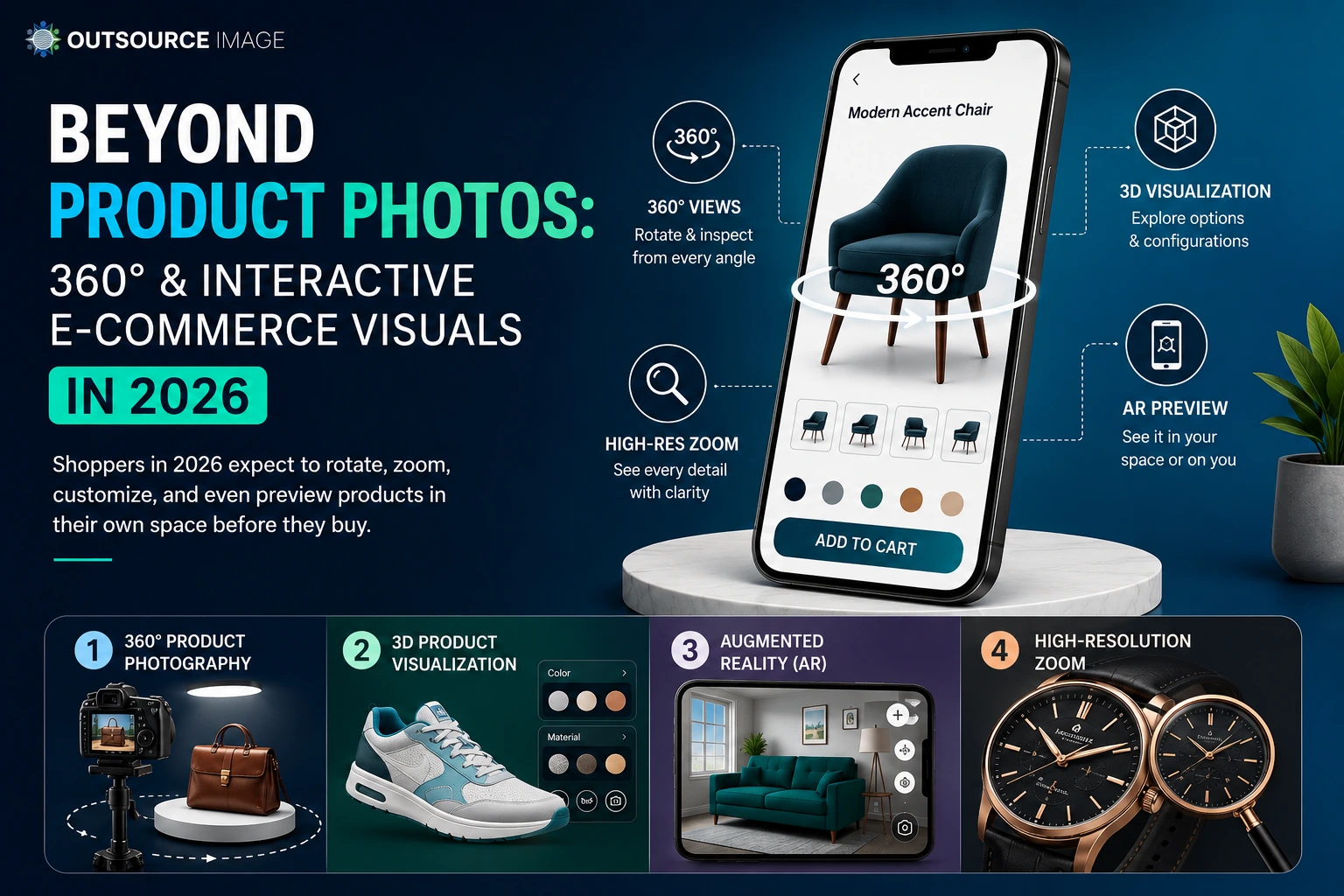
A handful of static product photos no longer cuts it. That’s why interactive e-commerce visuals 360° views, 3D models, AR previews, and zoom are becoming standard on product pages. Shoppers in 2026 expect to rotate, zoom, customize, and even preview products in their own space before they buy.
That said, traditional photography isn’t going away instead, it’s becoming the foundation that 360° views, 3D visualization, augmented reality (AR), interactive zoom, and product animation build on.
Interactive e-commerce visuals are product images and experiences shoppers can actively control rotating a 360° view, zooming into fine detail, spinning a 3D model, or placing an AR preview in their own space rather than a fixed, single-angle photo.
Why Static Photos Fall Short of Interactive E-Commerce Visuals
Online shoppers can’t pick a product up or feel its texture. A still photo shows what something looks like, but it may not fully convey scale, material, shape, or how a product functions.
As a result, interactive visuals help close that gap:
- 360° views let customers rotate a product and inspect it from every angle.
- High-resolution zoom reveals details such as stitching, fabric weave, surface finish, and craftsmanship.
- 3D visualization lets shoppers explore products digitally, including different configurations.
- AR allows shoppers to preview how a product looks in their space or on themselves.
Ultimately, the goal is simple: give customers enough information to buy with confidence. That starts with clean, accurate photography. In other words, good product retouching is the first layer, not an afterthought. It’s also important to understand the difference between image editing and image retouching, since both play different roles in a product workflow.
Four Formats of Interactive E-Commerce Visuals
1. 360° Product Photography
Instead of three or four fixed shots, customers get a fully rotatable view. This is especially valuable for jewelry, footwear, electronics, furniture, and accessories, where construction, shape, and finish matter. Similarly, just as 360° panorama editing adds context to real estate listings, a complete visual view can build buyer confidence.
2. 3D Product Visualization
Shoppers can explore options such as color, material, and finish and see the product update digitally. Consequently, this works especially well for furniture, fashion, home décor, and products available in multiple variants, because customers don’t have to imagine every option. Shopify’s own merchant data points to a sizeable conversion lift for product pages that use interactive 3D content instead of standard static images, and furniture retailers like Cylindo’s case studies show similarly strong gains in both conversion rate and average order value.
3. Augmented Reality
AR places a digital product into the customer’s real environment for example, a sofa in their living room or glasses on their face. For apparel and beauty in particular, accurate source assets and preparation are essential. Ghost mannequin editing, for instance, is one way of preparing product imagery for a realistic presentation.
At its core, AR answers a key question: will this actually work for me? The impact shows up in the numbers, too Shopify reports that a majority of shoppers now use AR before completing a purchase, and brands offering 3D and AR previews have seen meaningfully higher add-to-cart rates. Market research from Grand View Research similarly points to continued double-digit growth in AR adoption across e-commerce, driven largely by demand for virtual try-on and reduced returns.
4. High-Resolution Zoom
For premium products, small details can influence buying decisions. Therefore, zoom lets customers inspect leather grain, gemstone settings, fabric texture, engravings, and finish quality that a standard image may not fully reveal.
Consequently, detailed jewelry photo retouching and professional photo retouching services are valuable when building high-quality interactive catalogs. For luxury pieces specifically, jewelry photo retouching tips can help brands present craftsmanship convincingly.
Why Interactive E-Commerce Visuals Are Accelerating
AI Is Making Production More Efficient
Tasks such as background generation, upscaling, object cleanup, and scene creation can now be AI-assisted, which in turn helps brands produce visual content more efficiently. This reflects the broader evolution of image editing from darkrooms to AI tools.
However, speed isn’t the same as quality. Commercial visuals still need accurate color, realistic details, correct proportions, and consistent branding. That’s why many teams combine AI tools and human editors rather than relying entirely on one approach.
Mobile Shopping Demands Simplicity
Interactive experiences need to be intuitive: swipe to rotate, pinch to zoom, tap to explore, or point the camera to visualize. Nevertheless, if the experience is slow to load, even impressive technology can frustrate shoppers Shopify’s load-time research shows that a majority of mobile visitors leave a page that takes more than a few seconds to load, which makes compression and optimization non-negotiable for any interactive asset.
Buyer Expectations Have Shifted
Customers who experience 360° views or AR try-ons on one site may expect similar experiences elsewhere. Interest in these formats also varies by market Statista’s consumer research shows enthusiasm for AR/VR-enhanced shopping differs widely across countries, which is worth factoring in for brands selling internationally. Even so, brands relying only on flat photography risk appearing less competitive. This is one reason professional image editing can support stronger e-commerce presentation and sales performance, reinforcing the role of image editing in e-commerce success.
Where Interactive E-Commerce Visuals Matter Most
Fashion and footwear brands benefit because customers want to understand shape, material, construction, and color details a single photo may not fully convey.
Likewise, furniture and home décor sellers face similar challenges, since shoppers need to judge size, proportion, and how a product may look in their space.
For jewelry and luxury products in particular, details such as cuts, finishes, engravings, settings, and clasps are especially important. Here, 360° views and high-resolution zoom can showcase these details more effectively.
Meanwhile, for electronics and general product categories, interactive views can help customers examine ports, buttons, dimensions, and build quality from multiple angles. Automotive listings can benefit from the same approach for showcasing trim, interiors, and finishes.
Matching Interactive E-Commerce Visuals to the Right Problem
Interactive features should solve a specific customer concern, not just look impressive:
- Unsure about size? → Accurate dimensions or AR.
- Unsure about material? → High-resolution zoom.
- Want every angle? → 360° photography.
- Want to see variations? → 3D visualization.
In short, the best interactive experience is the one that removes hesitation not the one with the most features.
Good Photography: The Foundation of Interactive E-Commerce Visuals
Before any 360° view, 3D asset, or AR model is created, source photography needs to be clean and consistent — with properly handled backgrounds, color, lighting, shadows, and resolution. This is where image enhancement and photo clipping work together to prepare assets for downstream use.
This becomes especially important across large catalogs, as explained in our complete guide to background removal for online stores. Additionally, choosing the right outsourcing partner can help maintain consistency when editing hundreds or thousands of product images, and can save real time and money along the way.
In the end, interactive technology creates the experience but professional imagery is still what makes that experience credible, which is why quality image retouching is a must for e-commerce stores.
Where Interactive E-Commerce Visuals Are Heading
The future isn’t interactive replacing photography instead, it’s the two working together. A strong product page in 2026 can combine:
- Photography for brand storytelling
- 360° views for product inspection
- 3D visualization for customization
- AR for real-world context
- Zoom for material and craftsmanship
- Video for product functionality
Ultimately, the winning strategy isn’t using every technology available it’s choosing the right combination for the product, customer, and buying journey.
FAQ
1. Do I need 3D or AR if I already have good product photography?
Not necessarily. Strong photography is the foundation. That said, consider adding 3D or AR when better visualization could address customer questions about fit, size, or placement.
2. Which product categories benefit most from 360° photography?
Products where construction, shape, and finish matter benefit significantly. For example, jewelry, footwear, furniture, electronics, and accessories are good examples.
3. Does interactive content slow down my website?
It can, unless it’s optimized. Therefore, 360° views, 3D models, and AR assets should be compressed and designed for fast mobile loading.
4. Can AI fully replace professional photo editing for these formats?
AI can speed up background generation, upscaling, and cleanup. However, human quality control remains important for accurate colors, realistic details, correct proportions, and consistent branding see our take on AI vs. human editors.
5. Where should a brand start with interactive visuals?
Start with the customer question you’re trying to solve. For instance, fit or space concerns point toward AR; detail and craftsmanship point toward 360° views and zoom; product variations may benefit from 3D visualization.
Conclusion
360° photography, 3D visualization, AR, and high-resolution zoom can give shoppers more information and confidence to buy but only when built on accurate photography, consistent editing, fast load times, and purposeful design.
In short, static photography and interactive e-commerce visuals aren’t competing formats; they’re two parts of the same e-commerce strategy. The goal isn’t to use every technology available it’s to choose the right visual experience for the product and customer.
Ready to upgrade your product visuals?
Outsource Image helps e-commerce brands create professional, consistent, high-quality product visuals from retouching and background removal to image enhancement and 360° preparation.
- Website: www.outsourceimage.com
- Email: sales@outsourceimage.com
- Phone: +91 9345450713
Outsource Image Professional Image Editing for E-Commerce & Beyond.